Three Additional Hypotheses to Meredith Chivers' 10 Hypotheses

Below are three novel hypotheses to explain the gender-nonspecific arousal patterns of androphilic women. 

1. The Male-Biased Stimuli Hypothesis

Consider the genital arousal patterns of asexual men: 
Patterns of Genital and Subjective Arousal in Cisgender Asexual Men
Skorska et al. (2022)

Asexual men show relatively "indifferent" patterns of sexual arousal to the stimuli traditionally employed in these experiments, but not to sexual fantasies of their choosing:

Compared with gay and heterosexual men, asexual men demonstrated lower genital and subjective sexual arousal to the erotic films but displayed similar sexual arousal when engaging in sexual fantasy. Asexual men’s lower levels of sexual excitation rather than their higher levels of sexual inhibition were associated with lower responses to the erotic films. These findings suggest asexual men have preferred sexual stimuli that differ from sexual men and have a similar capacity for sexual arousal as sexual men. (Skorska et al., 2022)

Compare with the genital arousal patterns of androphilic women: 

A Sex Difference in the Specificity of Sexual Arousal
Chivers et al. (2004)

Unlike asexual men, androphilic women are sexually excited by the stimuli that are traditionally employed in these experiments. However, their peak level of sexual excitation is the lowest, and their patterns of arousal are also "indifferent". What if androphilic women have a similar capacity for gender-specific arousal, but they have preferred sexual stimuli that differ from those traditionally employed in these experiments?

The erotic stimuli typically employed in experiments of genital arousal were originally developed to measure the responses of males. As such, they usually involve male-female, female-female, and male-male erotica that is made by and for men. Chivers et al.'s (2004) experiment should be repeated with the top-rated male-female, female-female, and male-female erotica that is made by and for women, to determine if the sex difference in gender-specificity is real.

2. Hate/Love Hypothesis
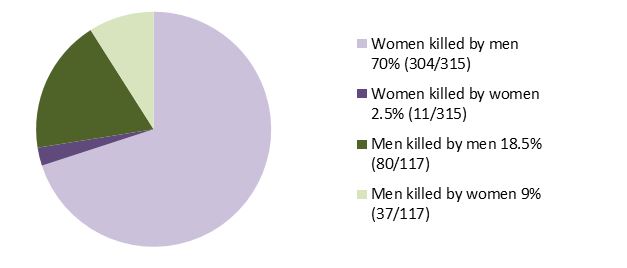
Intimate Partner and Domestic Violence Homicides*: Sex Differences
April 2012 – March 2015 (3 years) | Karen Ingala Smith

Heterosexual relationships differ from homosexual relationship due to an inherent imbalance between the sexes. Most males are bigger, stronger, and more aggressive than most females, where most victims of domestic violence and sexual abuse are female and most perpetrators are male. Lalumière et al. (2022) argue that, "the evidence is in favor of the notion that rape of women by men has been a ubiquitous feature of perhaps all human societies over evolutionary time (reviewed in Lalumière et al., 2005), providing strong selection pressures for the evolution of female defenses. There was probably no time or place in which girls and women were free from the threat of rape." 

As such, women are taught from a young age to have a "hate/love" relationship with men, needing men to have children but fearing the threat they pose. Heterosexual men, homosexual men, and homosexual women all associate their preferred sexual partners purely with reward. On the other hand, heterosexual women associate their preferred sexual partners with a mix of potential reward and potential pain, dulling the sexual response.

3. Homophobia Hypothesis

Most cultures view homosexuality negatively, and "greater homophobia" is often directed at male homosexuality (Apostolou, 2022)(Safron & Hoffmann, 2017). Heterosexual women's genital responses to male-male sexual activity could be a mixture of arousal and disgust, resulting in an attenuated response. 

A similar effect would not be found in heterosexual men's genital responses to female-female sexual activity, due to the lower homophobia directed at female homosexuality. It is also possible that males have evolved to take sexual interest in women who are sexually attracted to other women (Apostolou, 2022). 

Although heterosexual women "tend to dislike" viewing male-male pornography, Bailey (2025) explains why this hypothesis is probably wrong: "Some studies using erotica featuring single individual actors have examined women’s genital arousal and they show the same patterns." Indeed, this was reported by Chivers et al. (2007), who found that heterosexual women show nonspecific arousal to footage of solo masturbation. 

Further Reading

Related Blog Posts

References

Apostolou M. The Evolution of Female Same-Sex Attraction. In: Shackelford TK, ed. The Cambridge Handbook of Evolutionary Perspectives on Sexual Psychology. Cambridge Handbooks in Psychology. Cambridge University Press; 2022:28-51.

Chivers, M. L., Rieger, G., Latty, E., & Bailey, J. M. (2004). A sex difference in the specificity of sexual arousal. Psychological science, 15(11), 736-744.

Chivers, M. L., Seto, M. C., & Blanchard, R. (2007). Gender and sexual orientation differences in sexual response to sexual activities versus gender of actors in sexual films. Journal of personality and social psychology, 93(6), 1108.

Lalumière, M. L., Harris, G. T., Quinsey, V. L., & Rice, M. E. (2005). The causes of rape: Understanding individual differences in male propensity for sexual aggression (Vol. 46). Washington, DC: American Psychological Association.

Lalumière, M. L., Sawatsky, M. L., Dawson, S. J., & Suschinsky, K. D. (2022). The Preparation Hypothesis Bristles. Archives of Sexual Behavior, 51(2), 777-780.

Safron, A., & Hoffmann, H. (2017). What does sexual responsiveness to one’s nonpreferred sex mean? [Commentary]. Archives of Sexual Behavior. doi:10.1007/s10508-017-0954-0.

Skorska, M. N., Yule, M. A., Bogaert, A. F., & Brotto, L. A. (2023). Patterns of genital and subjective sexual arousal in cisgender asexual men. The Journal of Sex Research, 60(2), 253-270.

Comments

Popular posts from this blog

Is "Nonbinary" all Nonsense?

Commentary on "A Life History Approach to the Female Sexual Orientation Spectrum"

"Navel Gays" is Wrong about Autoandrophilia